Unlock your sound with the EDM Academy
Transform your passion for electronic music into professional skills. Our academy guides you from your first project to releasing professional-quality tracks.
What you will learn
The Bellagius Recordings EDM Academy is designed to help aspiring music producers transform their passion into professional skills. Our goal is to provide clear, practical, and industry-relevant education that guides students through every stage of electronic music production—from their very first project to releasing professional-quality tracks. Whether you're learning FL Studio, improving your mixing and mastering, designing unique sounds, understanding music theory, or building your artist brand, our academy gives you the knowledge, confidence, and creative mindset needed to succeed in today's electronic music industry.

Beginner foundations
Build a strong foundation in electronic music production, from basic concepts to your first track.

Intermediate techniques
Refine your mixing, sound design, arrangement, and production workflow with advanced lessons.

Advanced strategies
Explore professional production, music marketing, branding, and releasing your music through labels.
Who can benefit from our academy?
The Bellagius Recordings EDM Academy is primarily designed for beginners and intermediate music producers who want to build a solid foundation in electronic music production. Whether you're creating your first track or looking to improve your mixing, sound design, arrangement, or production workflow, our lessons are structured to help you progress step by step. More advanced producers can also benefit from specialized content covering professional production techniques, music marketing, branding, and releasing music through record labels and streaming platforms.

Our unique approach to learning
What makes the Bellagius Recordings EDM Academy unique is its real-world, practical approach to electronic music production. Instead of focusing only on software tutorials, we teach the complete journey of becoming a successful music producer. Students learn not only how to create professional-quality tracks, but also how to develop their own sound, build an artist brand, release music, understand the music industry, and grow a sustainable career. Every lesson is designed to be practical, easy to follow, and based on real production workflows used in modern electronic music.
Take the next step in your music career
After visiting the Bellagius Recordings EDM Academy, we want visitors to take the next step in their learning journey. Whether that's exploring our free educational articles, subscribing for future tutorials, joining our growing producer community, or starting to create their next track, our goal is to inspire continuous learning and creative growth.

How to Start Producing EDM in 2026: The Complete Beginner's Guide
Electronic music has never been more accessible than it is today. A laptop, a pair of headphones, and the right software are enough to begin creating tracks that can reach listeners around the world. Every year thousands of aspiring producers open their first Digital Audio Workstation (DAW) with the dream of releasing music on streaming platforms or signing with a record label.
The challenge is that many beginners don't know where to start. The internet is full of tutorials, plugin reviews, and conflicting advice. One creator says you need expensive equipment. Another insists that mastering music theory is the first step. Others claim AI will do most of the work for you.
The truth is much simpler.
Great producers are built through consistent practice, curiosity, and understanding the fundamentals.
This guide will walk you through everything you need to begin producing EDM in 2026—from choosing your software to completing your very first track.
What is EDM?
Electronic Dance Music, commonly known as EDM, is a broad category of electronic music created primarily with digital instruments, synthesizers, drum machines, and computer software.
Within EDM you'll find many different styles, including:
- House
- Progressive House
- Deep House
- Tech House
- Trance
- Progressive Trance
- Melodic House
- Future Bass
- Drum & Bass
- Dubstep
- Hardstyle
Although every genre has its own identity, they all share the same production workflow. Learning the fundamentals allows you to move between genres much more easily.
Choosing Your First DAW
A Digital Audio Workstation is the software where every part of your music is created, edited, mixed, and exported.
Popular choices include:
FL Studio
Perfect for beginners thanks to its intuitive workflow, Piano Roll, and pattern-based sequencing. It has become one of the most widely used DAWs in electronic music production.
Ideal for:
- EDM
- House
- Trance
- Future Bass
- Trap
Ableton Live
Known for its creative workflow and powerful live performance capabilities. Many professional electronic artists rely on Ableton because of its speed and flexibility.
Ideal for:
- Techno
- House
- Experimental music
- Live performances
Logic Pro
Available exclusively for macOS, Logic Pro offers a complete production environment with excellent built-in instruments and effects.
Ideal for:
- Songwriting
- Electronic music
- Film scoring
- Pop production
Which One Should You Choose?
If your primary goal is producing EDM as a beginner, FL Studio remains one of the easiest platforms to learn while still being powerful enough for professional releases.
The most important decision is not which DAW you choose it is committing to one and learning it deeply.
Do You Need Expensive Equipment?
One of the biggest misconceptions in music production is believing that expensive gear automatically leads to better music.
Professional equipment certainly improves the workflow, but it does not replace creativity or experience.
A simple beginner setup might include:
- A modern laptop or desktop computer
- FL Studio or another DAW
- Closed-back studio headphones
- An entry-level MIDI keyboard (optional)
- A quiet workspace
Many successful producers created their earliest releases using surprisingly modest equipment.
Learn Music Theory, But Don't Overcomplicate It
Music theory often intimidates beginners, yet only a handful of concepts are needed to start producing electronic music effectively.
Focus on understanding:
- Major and minor scales
- Chords
- Rhythm
- Song keys
- Basic intervals
Learning these fundamentals will help you write stronger melodies, emotional chord progressions, and basslines that work together naturally.
Understanding Sound Design
Modern EDM is built around synthesizers.
Instead of relying only on presets, take time to understand how sounds are created.
Learn how:
- Oscillators generate waveforms.
- Filters shape tonal character.
- Envelopes control volume over time.
- LFOs introduce movement and modulation.
- Effects transform raw sounds into polished textures.
Mastering these basics opens the door to creating your own signature sound.
Build Your First Track
Many beginners spend months making short loops without ever finishing a complete song.
A better approach is to finish simple projects from start to finish.
A basic arrangement might look like this:
- Intro
- Build-up
- Drop
- Breakdown
- Second Build-up
- Final Drop
- Outro
Completing tracks teaches far more than endlessly perfecting eight-bar loops.
Mixing Basics
A great composition deserves a clean mix.
Start by learning:
- Volume balancing
- EQ
- Compression
- Stereo width
- Reverb
- Delay
Good mixing isn't about making everything louder it's about giving every element its own space.
Mastering
Mastering prepares your track for release across streaming services and digital stores.
Its purpose is to create consistency, clarity, and competitive loudness while preserving the musical dynamics.
Avoid chasing maximum loudness at the expense of sound quality.
Develop Your Own Style
Many new producers imitate their favorite artists.
That is a natural part of learning.
As your experience grows, experiment with different genres, sound design techniques, rhythms, and melodies until your music develops its own recognizable identity.
Originality comes from combining influences rather than copying them.
Practice Every Week
Consistency always outperforms occasional bursts of inspiration.
Even 30–60 minutes of focused production several times a week will produce meaningful progress over the course of a year.
The producers who improve the fastest are usually the ones who keep creating, finishing tracks, and learning from each project.
Common Beginner Mistakes
Avoid these common pitfalls:
- Buying too many plugins before mastering the basics.
- Watching tutorials instead of practicing.
- Constantly switching between DAWs.
- Comparing your first tracks to professional releases.
- Never finishing songs.
- Ignoring arrangement and song structure.
- Spending hours searching for the perfect preset.
Progress comes from creating music consistently, not from collecting tools.
Final Thoughts
Starting your EDM production journey in 2026 is easier than ever before. The tools are more accessible, learning resources are everywhere, and the opportunity to share your music with a global audience has never been greater.
Success doesn't depend on owning the most expensive equipment or using the most popular plugins. It comes from building strong fundamentals, practicing consistently, and finishing projects that help you grow with every release.
Every professional producer once opened a DAW for the very first time. Your first track won't be perfect—and it doesn't need to be. What matters is taking that first step, staying curious, and continuing to learn.
The journey from beginner to confident producer is built one project at a time.
Frequently Asked Questions
How long does it take to learn EDM production?
Most beginners can create complete tracks within a few months of consistent practice. Developing professional-level skills usually takes several years of focused learning and experience.
Is FL Studio good for beginners?
Yes. FL Studio offers an intuitive workflow, a powerful Piano Roll, and a large ecosystem of tutorials, making it one of the most beginner-friendly DAWs for EDM production.
Do I need music theory?
A basic understanding of scales, chords, rhythm, and song structure is highly beneficial. You don't need advanced theory to start producing great electronic music.
Can I produce music without expensive equipment?
Absolutely. A capable computer, a DAW, and a good pair of headphones are enough to begin creating high-quality music.
Continue Your Producer Journey
This guide is just the beginning. Explore more free tutorials from the Bellagius Recordings EDM Academy to deepen your skills in sound design, mixing, mastering, music theory, and building a successful career in electronic music.
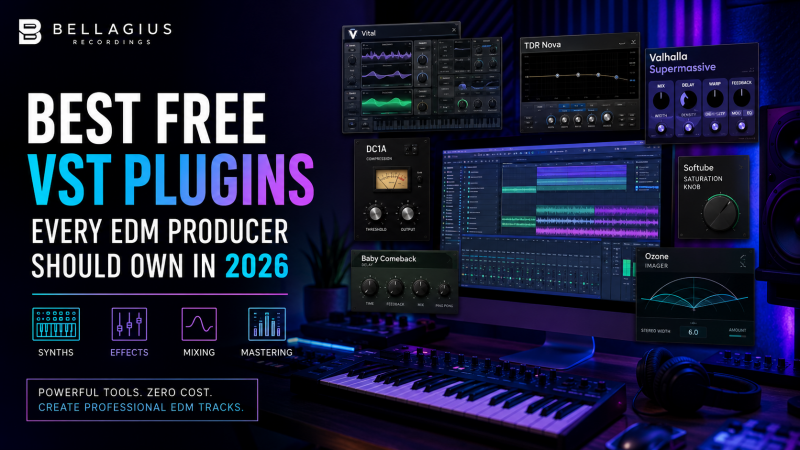
Best Free VST Plugins Every EDM Producer Should Own in 2026
One of the first questions every new music producer asks is, "Which plugins should I download?" The internet is full of recommendations, sponsored videos, and endless lists claiming to reveal the "ultimate" collection of VSTs.
It's easy to fall into the trap of downloading dozens of plugins before learning how to use even one of them effectively. In reality, a small collection of high-quality free plugins is enough to produce professional-sounding tracks.
This guide highlights some of the best free VST plugins available in 2026 and explains why each deserves a place in your production workflow.
What Is a VST Plugin?
A VST (Virtual Studio Technology) plugin expands the capabilities of your Digital Audio Workstation (DAW). Plugins generally fall into two categories:
- Instrument plugins generate sounds, such as synthesizers, pianos, or drum machines.
- Effect plugins process audio using tools like EQ, compression, reverb, delay, or saturation.
Together, they form the foundation of every modern EDM production.
Why Free Plugins Are Worth Using
There's a common misconception that expensive plugins automatically produce better music. While premium tools often offer additional features, many free plugins deliver exceptional sound quality.
Free plugins allow you to:
- Build your production toolkit without financial pressure.
- Learn the fundamentals before investing in premium software.
- Discover different workflows and sound design techniques.
- Focus on creativity instead of collecting tools.
The quality of your music depends far more on your skills than on the price tag of your plugins.
Best Free Synthesizers
Vital
Vital has quickly become one of the most respected free wavetable synthesizers. Its modern interface, powerful modulation system, and excellent sound quality make it suitable for everything from deep basses to cinematic pads and aggressive leads.
Perfect for:
- Future Bass
- Progressive House
- Melodic Techno
- Dubstep
- Trance
Surge XT
Surge XT is a fully open-source synthesizer with multiple synthesis engines and an impressive range of presets. It offers professional-level flexibility and can handle nearly any electronic genre.
Strengths include:
- Multiple oscillator types
- Extensive modulation
- Excellent factory presets
- Active community support
Dexed
Inspired by the legendary Yamaha DX7, Dexed specializes in FM synthesis. It excels at creating electric pianos, bells, plucks, and metallic textures that remain popular in modern electronic music.
Best Free EQ Plugins
TDR Nova
TDR Nova combines a traditional equalizer with dynamic processing. This makes it ideal for controlling harsh frequencies while maintaining a natural sound.
Use it for:
- Vocals
- Synth leads
- Pads
- Drums
- Master bus corrections
Best Free Compression Plugins
DC1A Compressor
DC1A is intentionally simple. With only a few controls, it allows beginners to understand compression without becoming overwhelmed.
Ideal applications:
- Bass
- Vocals
- Drum buses
- Synth groups
Best Free Reverb
Valhalla Supermassive
One of the most beloved free effects in electronic music production, Valhalla Supermassive creates lush reverbs, expansive delays, and atmospheric soundscapes.
It's especially useful for:
- Ambient intros
- Cinematic transitions
- Pads
- Vocal effects
- Melodic breakdowns
Best Free Delay
Baby Comeback
This versatile delay plugin offers tape-style warmth, modulation, and intuitive controls. It's perfect for adding depth and movement to melodies and vocals.
Best Free Saturation
Softube Saturation Knob
A subtle amount of saturation can add warmth and presence to almost any sound. Softube Saturation Knob is straightforward, musical, and easy to use.
Try it on:
- Bass
- Drums
- Synths
- Vocals
Best Free Stereo Imaging
Ozone Imager
Stereo width plays a major role in modern EDM. Ozone Imager helps create a spacious mix while remaining compatible with mono playback.
Use it carefully. Excessive widening can weaken your mix and cause phase issues.
How Many Plugins Do You Actually Need?
Many producers spend more time downloading plugins than making music. A focused toolkit is usually far more effective.
A solid beginner setup could include:
- One synthesizer
- One EQ
- One compressor
- One reverb
- One delay
- One saturation plugin
- One stereo imaging tool
Learning these thoroughly will take you much further than owning hundreds of plugins.
Organize Your Plugin Library
A clean workspace improves productivity. Group your plugins into folders such as:
- Synths
- EQ
- Compression
- Reverb
- Delay
- Distortion
- Utility
- Mastering
Finding the right tool quickly keeps you focused on creating rather than searching.
Common Mistakes
Avoid these habits:
- Installing every free plugin you find.
- Assuming premium plugins guarantee better music.
- Ignoring stock plugins included with your DAW.
- Using too many effects on every channel.
- Changing plugins constantly instead of mastering one.
Consistency in your workflow often matters more than the size of your collection.
Final Thoughts
Free VST plugins have reached an impressive level of quality. Many are capable of producing professional results and are used daily by experienced producers around the world.
Instead of chasing an ever-growing plugin library, focus on understanding a handful of reliable tools. As your skills develop, you'll know exactly which premium plugins are worth investing in—and which ones you can happily live without.
Remember: great music comes from creative decisions, not from the number of plugins installed on your computer.
Frequently Asked Questions
Are free VST plugins good enough for professional music?
Yes. Many free plugins offer outstanding sound quality and are suitable for commercial releases when used effectively.
Can I make EDM using only free plugins?
Absolutely. A capable DAW combined with a carefully chosen selection of free instruments and effects is enough to produce professional-quality tracks.
Should beginners buy expensive plugin bundles?
It's usually better to master a small collection of free tools before investing in premium software. Experience helps you identify what your workflow actually needs.
Do stock plugins still matter?
Definitely. Most modern DAWs include excellent built-in plugins that cover the majority of everyday production tasks.
Continue Your Producer Journey
The right plugins are only part of the equation. In the next lessons from the Bellagius Recordings EDM Academy, you'll learn how to use them effectively through practical tutorials on sound design, mixing, mastering, and complete track production.
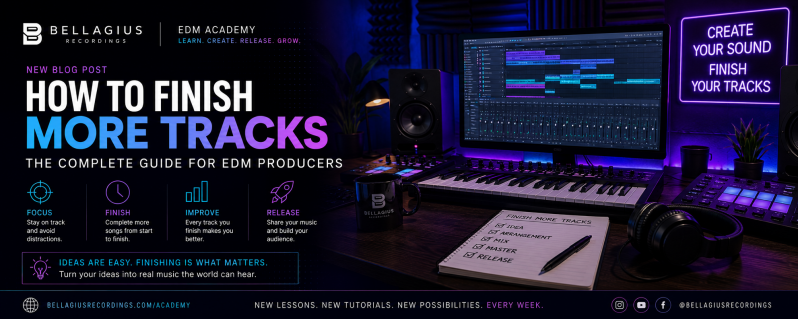
How to Finish More Tracks: The Complete Guide for EDM Producers
Ask almost any music producer about their hard drive, and you'll hear the same story.
Hundreds of unfinished projects.
Dozens of promising ideas.
Only a handful of completed songs.
This is one of the biggest obstacles in electronic music production. Finishing tracks is a skill that separates hobbyists from artists who consistently release music.
The good news is that completing songs is something you can learn.
Why Most Producers Never Finish Their Music
Starting a track is exciting. Everything feels new, and ideas come quickly.
The challenge begins when the initial excitement fades. Arranging the second half of the song, refining transitions, balancing the mix, and making creative decisions require discipline more than inspiration.
Professional producers don't finish songs because every session feels magical.
They finish songs because they have a process.
Perfection Is the Biggest Enemy
Many beginners believe their first release should sound like a festival anthem.
That expectation creates frustration.
Instead of moving forward, they keep changing the same eight bars over and over.
Progress comes from finishing many tracks, not endlessly polishing one.
Every completed project teaches something new.
Stop Collecting Loops
Creating a great eight-bar loop is fun.
Turning it into a complete arrangement is where real production begins.
If your projects rarely move beyond the drop, challenge yourself to build a full song before making the loop perfect.
A complete track with small imperfections is more valuable than a perfect loop that never becomes a song.
Use a Simple Workflow
Decision fatigue slows creativity.
Having a repeatable workflow helps you stay focused.
For example:
- Create the main idea.
- Build the drop.
- Add the intro.
- Create the breakdown.
- Build transitions.
- Arrange the full track.
- Mix.
- Export.
- Listen the next day.
- Make final adjustments.
Following the same process for every project reduces unnecessary decisions.
Set Time Limits
Unlimited time often leads to unlimited revisions.
Try setting realistic deadlines.
For example:
- Sound design: 45 minutes
- Drum programming: 30 minutes
- Arrangement: 90 minutes
- Mixing: 2 hours
Time limits encourage decisive creative choices.
Separate Creativity from Editing
Trying to write melodies while simultaneously adjusting EQ settings interrupts your creative flow.
During writing sessions:
Focus on ideas.
During mixing sessions:
Focus on technical improvements.
Keeping these stages separate helps maintain momentum.
Learn to Accept "Good Enough"
Professional producers know that every track could be improved forever.
Eventually, you must decide that the song communicates your idea well enough to release.
Perfection isn't the goal.
Completion is.
Build a Release Habit
One completed song every month is better than twelve unfinished projects.
Publishing consistently improves:
- Production skills
- Confidence
- Audience growth
- Portfolio quality
Each release becomes a stepping stone toward the next.
Organize Your Projects
A messy project folder creates unnecessary friction.
Create folders such as:
- Ideas
- In Progress
- Mixing
- Mastering
- Ready to Release
- Released
A clear system makes it easier to return to older projects and track your progress.
Don't Compare Your Beginning to Someone Else's Peak
Every successful producer has years of practice behind their best releases.
Comparing your tenth project to someone else's thousandth is discouraging and unrealistic.
Focus on becoming better than you were last month.
Small improvements accumulate into remarkable progress over time.
Common Mistakes
Avoid these habits:
- Starting new songs every day.
- Buying new plugins instead of practicing.
- Chasing perfection.
- Ignoring arrangement.
- Never setting deadlines.
- Constantly switching genres.
- Waiting for inspiration before working.
Discipline creates consistency.
Consistency creates results.
Final Thoughts
Finishing tracks is one of the most valuable habits any music producer can develop.
Every completed project strengthens your understanding of composition, arrangement, mixing, and sound design. More importantly, it builds confidence. You stop wondering whether you can finish a song because you've already done it.
The goal isn't to create a masterpiece every time you open your DAW. The goal is to keep moving forward, one finished track after another.
Great producers aren't defined by the number of ideas they have. They're remembered for the music they release.
Frequently Asked Questions
How many tracks should I finish each year?
Aim for consistency rather than a specific number. Even one completed track each month will lead to significant improvement over time.
Is it normal to lose motivation halfway through a song?
Yes. Most producers experience this. Having a structured workflow and realistic deadlines helps maintain momentum.
Should I abandon a track if I don't like it anymore?
Not immediately. Finish it first if possible. The experience of completing a project often provides more value than starting a new one.
How do professionals stay productive?
They rely on routines, deadlines, and repeatable workflows rather than waiting for inspiration.
Continue Your Producer Journey
Every finished track brings you closer to your goals. Continue exploring the Bellagius Recordings EDM Academy for practical guides on arrangement, mixing, sound design, music marketing, and everything you need to grow as an electronic music producer.
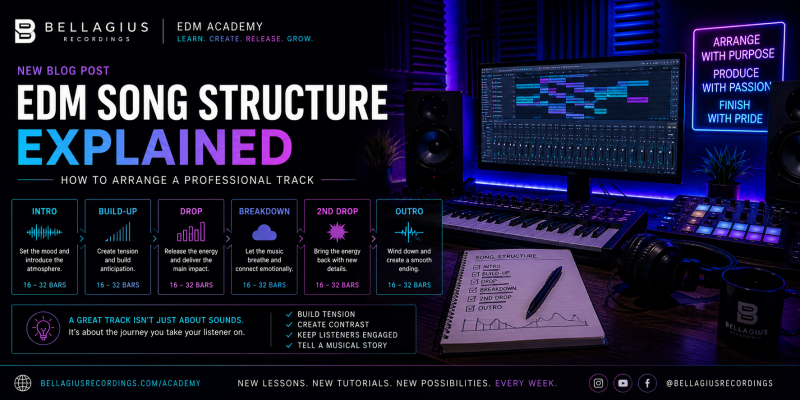
EDM Song Structure Explained: How to Arrange a Professional Track
One of the biggest differences between beginners and experienced producers isn't sound design or mixing it's arrangement.
Many producers can create an impressive eight-bar loop. Turning that loop into a complete, engaging track is where the real challenge begins.
A well-structured arrangement keeps listeners interested, builds anticipation, and delivers satisfying moments throughout the song. Whether you're producing House, Trance, Future Bass, or Techno, understanding song structure is essential.
Let's break down the anatomy of a professional EDM track.
Why Song Structure Matters
Arrangement is the roadmap of your music.
Without direction, even the best sounds lose their impact. Every section of a track should guide the listener naturally toward the next moment.
Good arrangement creates:
- Energy
- Contrast
- Emotion
- Tension
- Release
These elements transform a collection of sounds into a memorable musical experience.
The Typical EDM Arrangement
Although every genre has its own style, most EDM tracks follow a familiar structure.
A common arrangement looks like this:
Intro → Build-up → Drop → Breakdown → Build-up → Second Drop → Outro
This formula has remained popular because it works. Each section serves a specific purpose and contributes to the overall flow of the track.
Intro: Setting the Mood
The intro introduces your musical world.
It's often simpler than the rest of the track, giving DJs room to mix and listeners time to settle into the atmosphere.
A strong intro may include:
- Ambient textures
- Pads
- Light percussion
- Bass hints
- Simple melodies
Avoid revealing every element immediately. Leave room for the track to grow.
Build-Up: Creating Anticipation
The build-up increases excitement before the drop.
Here you'll gradually introduce new elements while raising the energy.
Common techniques include:
- Snare rolls
- Risers
- White noise
- Pitch automation
- Drum fills
- Filter sweeps
Each addition should make the listener feel that something bigger is about to happen.
Drop: The Main Event
The drop is where your track reaches its highest energy.
This is the section people remember.
An effective drop combines:
- Powerful drums
- Strong bass
- Memorable lead melodies
- Dynamic automation
- Clear rhythmic movement
Resist the urge to overload the mix. Every element should have a purpose.
Breakdown: Let the Music Breathe
After the intensity of the drop, the breakdown gives listeners a chance to reset emotionally.
This section often features:
- Piano
- Pads
- Atmospheric effects
- Vocal phrases
- Emotional chord progressions
A great breakdown creates contrast, making the next drop feel even more impactful.
The Second Drop
Many producers simply copy and paste the first drop.
Instead, introduce subtle changes:
- Additional percussion
- New fills
- Layered synths
- Different bass variations
- Fresh automation
Small differences keep the arrangement exciting without losing familiarity.
Outro
The outro gradually removes elements and prepares the track for a smooth ending.
For DJ-friendly music, this section often contains:
- Kick
- Percussion
- Bass
- Minimal melodic content
A clean outro also makes mixing easier during live performances.
Keep the Listener Interested
Professional arrangements rarely repeat exactly.
Every 8 or 16 bars, consider introducing a change such as:
- Automation
- Drum variation
- Reverse effects
- FX transitions
- Melody variations
- New percussion
These small adjustments maintain momentum.
Study Professional Tracks
One of the fastest ways to improve is by analyzing music you admire.
Import a reference track into your DAW and mark each section.
Notice:
- How long each part lasts.
- Where energy rises and falls.
- When new elements appear.
- How transitions are handled.
This exercise trains your ears and strengthens your arrangement skills.
Common Arrangement Mistakes
Avoid these common pitfalls:
- Repeating loops for too long.
- Introducing every sound at once.
- Weak transitions.
- No contrast between sections.
- Drops that feel smaller than the build-up.
- Forgetting automation.
- Abrupt endings.
Every section should support the journey of the listener.
Final Thoughts
A great arrangement tells a story.
It guides listeners through moments of anticipation, excitement, reflection, and release. While there is no single formula that fits every genre, understanding the purpose of each section gives you the confidence to create tracks that feel complete and professional.
The more songs you finish, the more naturally arrangement decisions will come. Over time, you'll develop your own style while keeping listeners engaged from the first beat to the final fade-out.
Frequently Asked Questions
How long should an EDM intro be?
For DJ-friendly tracks, intros often range from 16 to 32 bars. Streaming-focused releases may use shorter intros to reach the main hook more quickly.
Should every EDM track have two drops?
Not necessarily. Many tracks do, but the arrangement should support the musical idea rather than follow a fixed template.
Can I break the traditional song structure?
Absolutely. Understanding common structures gives you the freedom to experiment intentionally while maintaining a coherent listening experience.
What's the best way to improve arrangement skills?
Analyze professional tracks, finish your own songs regularly, and compare your arrangements with reference productions to identify areas for improvement.
Continue Your Producer Journey
Arrangement is the foundation of every memorable EDM track. Explore more guides from the Bellagius Recordings EDM Academy and continue building your skills in songwriting, sound design, mixing, mastering, and professional music production.
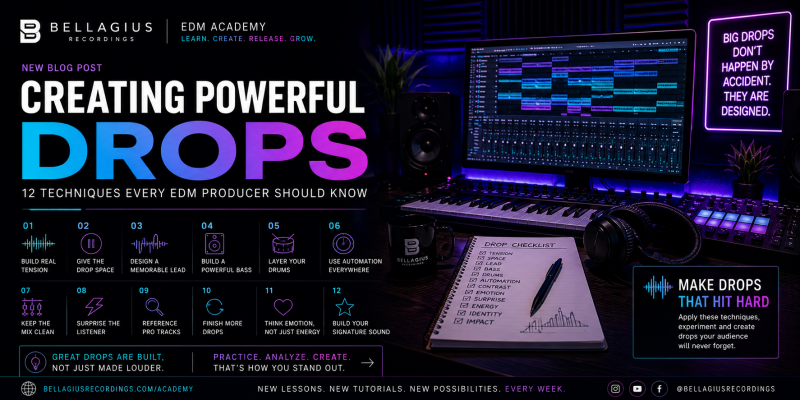
Creating Powerful Drops: 12 Techniques Every EDM Producer Should Know
Ask any EDM fan what they remember most about a track, and the answer is usually the same:
The drop.
It's the emotional payoff. The moment where tension turns into energy and anticipation becomes excitement.
A powerful drop isn't created by simply making everything louder. The best drops are carefully designed long before the first kick drum lands.
Here's how professional producers make their drops feel bigger, cleaner, and more exciting.
1. Build Real Tension
A drop only feels powerful if the listener has something to anticipate.
Before the drop, gradually increase the energy by introducing:
- Snare rolls
- White noise risers
- Filter automation
- Drum fills
- Pitch risers
- Reverse effects
The goal is to create expectation.
Without tension, the drop has nothing to release.
2. Give the Drop Space
Many beginners make one mistake:
Everything plays at once.
Professional drops often remove elements just before impact.
One beat of silence...
Half a bar without the kick...
A quick vocal stop...
These tiny moments create huge psychological impact.
Sometimes less sound creates more energy.
3. Design a Memorable Lead
People rarely remember compressors.
They remember melodies.
Whether it's Progressive House, Trance or Future Bass, your lead should be recognizable after only a few notes.
Try combining:
- Supersaws
- Plucks
- Layered synths
- Octaves
- Harmonies
A strong melody gives the drop identity.
4. Build a Powerful Bass
The bass carries the physical energy of the track.
Instead of relying on one sound, layer different basses.
For example:
- Sub Bass
- Mid Bass
- Distortion Layer
- Stereo Texture
Each layer serves a different purpose while leaving room for the kick.
5. Layer Your Drums
One kick.
One clap.
One hi-hat.
That usually isn't enough.
Professional drums are often built from multiple carefully selected layers.
Each contributes something unique:
- Punch
- Click
- Body
- Width
- Character
Together they create a fuller, more powerful rhythm.
6. Use Automation Everywhere
Static drops feel lifeless.
Automation introduces movement.
Automate:
- Filter cutoff
- Reverb
- Delay
- Stereo width
- Volume
- Distortion
- Pitch
Small changes make the drop evolve instead of repeating.
7. Keep the Mix Clean
Adding more sounds doesn't always make a drop bigger.
Too many competing frequencies reduce clarity.
Every instrument should have its own place.
Good EQ and level balancing often create more impact than adding another synth.
8. Surprise the Listener
Unexpected moments keep listeners engaged.
Ideas include:
- Vocal chops
- Fake drops
- Drum breaks
- Tempo pauses
- FX transitions
- Rhythm changes
A small surprise can make a track memorable.
9. Reference Professional Tracks
Choose songs you admire.
Compare:
- Energy
- Loudness
- Arrangement
- Stereo image
- Bass balance
- Drum punch
Learning from reference tracks accelerates your progress.
10. Finish More Drops
Some producers spend weeks improving one drop.
Others create twenty.
Guess who improves faster?
Experience comes through repetition.
Each finished track teaches new lessons.
11. Think About Emotion, Not Just Energy
The biggest festival drops aren't always the loudest.
They're emotional.
A simple melody, powerful chords, and dynamic contrast often create a stronger reaction than endless layers of sound.
Ask yourself:
What should the listener feel?
That answer should guide every production decision.
12. Build Your Own Signature Sound
Every famous producer has recognizable characteristics.
It might be:
- Unique basses
- Distinctive leads
- Special FX
- Vocal processing
- Drum style
- Melodic choices
Don't chase someone else's sound forever.
Experiment until listeners begin to recognize yours.
Common Mistakes
Avoid these common problems:
- Drops that are louder but not more exciting.
- Too many synth layers.
- Weak build-ups.
- Poor kick and bass balance.
- Over-compression.
- No variation in the second drop.
- Copying trends without adding your own identity.
A memorable drop is built through intention, not complexity.
Final Thoughts
The drop is where your creative vision comes to life. It's the reward for the listener's attention and one of the defining moments of any EDM track.
The strongest drops combine thoughtful arrangement, impactful sound design, solid mixing, and emotional intent. They don't rely on volume alone they create contrast, movement, and excitement.
As with every production skill, improvement comes from practice. Analyze the drops you love, experiment with new ideas, and finish your tracks. Over time, you'll develop a sound that is unmistakably your own.
Frequently Asked Questions
How many layers should a drop have?
There's no fixed number. Use only the layers that contribute something meaningful to the sound and avoid adding elements that create unnecessary clutter.
Why does my drop sound weak?
Common reasons include insufficient build-up, poor frequency balance, lack of contrast, or too many competing sounds.
Should every drop be different?
Small variations between drops help keep the arrangement engaging while maintaining a familiar musical identity.
What's the fastest way to improve my drops?
Study professional reference tracks, finish complete songs, and analyze what creates impact in different EDM genres.
Continue Your Producer Journey
Every unforgettable EDM track starts with a powerful idea and a well-crafted drop. Continue exploring the Bellagius Recordings EDM Academy for in-depth guides on sound design, mixing, arrangement, music theory, and professional production techniques.
